
IBM FlashSystem 5600 FS5600 5127-A20
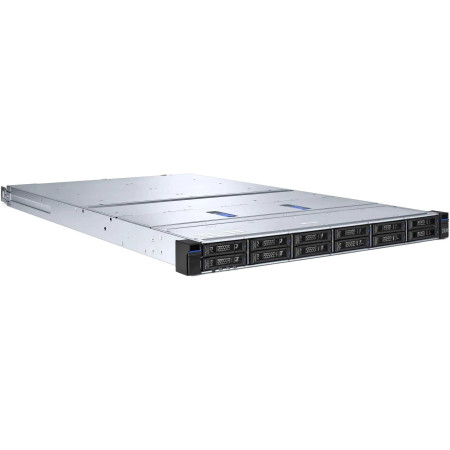
IBM FlashSystem 5600 FS5600 5127-A20
IBM FlashSystem 5600 FS5600 5127-A20 is a compact enterprise NVMe storage system for smaller mixed workloads, transactional applications and growing storage environments. It delivers up to 2.6 million 4K read-hit IOPS and 30 GB/s bandwidth in a 1U enclosure. The IBM FlashSystem 5600 FS5600 5127-A20 control enclosure combines 12 internal NVMe drive slots, IBM FlashCore Module 5 technology and redundant controller components. The IBM FS5600 has an effective capacity of up to 2.4 PBe within the 5127-A20 control enclosure.
Use the email price feature on the IBM FS7600 product page to request a configuration and pricing, or contact Midland Information Systems at (888) 682-5335. View other IBM FlashSystems or use the email price feature for a fully configure FlashSytem, upgrade or request pricing for replacement parts. All IBM FlashSytem products include warranty, support and may include services for installation and configuration.
IBM FlashSystem 5600 Performance Specifications
| Specification | Published single-enclosure maximum |
|---|---|
| IOPS | 2.6 million, 4K read hit |
| Read bandwidth | 30 GB/s |
| Read response time | Less than 50 microseconds |
| Raw internal capacity | Approximately 633 TB |
| Effective internal capacity | Up to 2.4 PBe |
| I/O ports | Up to 16 |
These are separate published maximums, not guaranteed simultaneous application results. Read-hit IOPS measure requests served from cache. Actual performance depends on I/O size, read/write mix, data services, drive configuration and host connections.
Raw capacity describes installed media. Usable capacity accounts for protection and system overhead. Effective capacity includes data reduction and depends on the stored data. IBM performance and capacity specifications
5127-A20 Hardware and Memory
| Component | Specification |
|---|---|
| Machine type and model | 5127-A20 |
| Rack height | 1U |
| Internal NVMe slots | 12 |
| Node canisters | 2 |
| Power supplies | 2 |
| Drive form factor | EDSFF |
| Minimum software level | IBM Storage Virtualize 9.1.2 |
The 5127-A20 is identified by IBM as the FlashSystem 5600 controller with Expert Care. Individual options and functions may require additional configuration checks. IBM system overview
IBM lists two 12-core Intel Xeon processors, providing 24 processor cores in total, with 256 GB or 512 GB system memory. IBM hardware specifications
FlashCore Module 5 and Internal Drives
| FCM5 option | Nominal raw capacity per module |
|---|---|
| Small | 6.6 TB |
| Medium | 13.2 TB |
| Large | 26.4 TB |
| Extra large | 52.8 TB |
A full population of twelve 52.8 TB modules totals 633.6 TB nominal raw capacity, calculated before RAID and system overhead.
Select modules around required usable capacity, growth and data compressibility. Verify supported population rules and ordering features before purchase. IBM FlashCore capacity specifications
Fibre Channel and Ethernet Connectivity
| Connection | Speeds | Host protocols |
|---|---|---|
| Standard Ethernet | 10/25 Gb/s | iSCSI or NVMe/TCP |
| Optional Fibre Channel | 32 or 64 Gb/s | Fibre Channel or NVMe/FC |
| Optional high-speed Ethernet | 40 or 100 Gb/s | iSCSI or NVMe/TCP |
| Optional Ethernet | 10 or 25 Gb/s | iSCSI or NVMe/TCP |
The enclosure supports up to 16 I/O ports. Available combinations depend on adapters, optics and cabling. IBM connectivity specifications
Port speeds are measured in gigabits per second; system bandwidth is measured in gigabytes per second. Evaluate the complete host-to-storage connection when sizing throughput.
SAS Expansion Enclosures
FlashSystem 5600 can add capacity through supported SAS expansion enclosures:
| Expansion model | Rack height | Drive bays |
|---|---|---|
| 4662-12G | 2U | 12 |
| 4662-92G | 5U | 92 |
IBM lists both expansion models with Expert Care and a minimum Storage Virtualize level of 9.1.2. Expansion drives use SAS attachment; the control enclosure’s internal drives use NVMe. IBM supported expansion models
Confirm the permitted enclosure count, SAS attachment configuration, drive types and total capacity for the proposed system. Expansion-bay counts alone do not establish a supported maximum configuration.
Snapshots and FlashCopy Maximums
The following FS5600 limits apply to IBM Storage Virtualize 9.1.2.x:
| Function | Maximum |
|---|---|
| Snapshots per system | 15,863 |
| Thin-clone or clone volumes per system | 8,191 |
| Snapshot policies per system | 128 |
| Safeguarded policies per system | 32 |
| FlashCopy mappings per system | 8,192 |
| FlashCopy consistency groups | 500 |
| FlashCopy mappings per consistency group | 512 |
| FlashCopy targets per source | 256 |
These are software configuration ceilings. Practical retention depends on volume configuration, available capacity, data change rate and applicable memory allowances. IBM snapshot and FlashCopy limits
FlashSystem Grid Scalability
IBM publishes these aggregate figures for a grid containing 32 similarly configured FS5600 systems:
| Grid specification | Published aggregate maximum |
|---|---|
| Effective capacity | 77 PBe |
| Read bandwidth | 960 GB/s |
| I/O ports | 512 |
These figures describe combined grid resources, not one enclosure’s performance or a single application’s throughput. IBM FlashSystem grid specifications
Storage Virtualize 9.1.2 lists one control enclosure and two active nodes per FS5600 system, with up to 32 systems per grid. IBM system and grid limits
Cyber Resilience and Recovery Planning
IBM positions FlashSystem 5600 and FCM5 around integrated threat detection, compression and resilient storage operations. Configure these capabilities alongside tested recovery procedures and appropriate access controls. IBM FlashSystem 5600 features
Define snapshot retention, recovery points and recovery-time requirements around the applications the storage supports.
Request an IBM FlashSystem 5600 Configuration Review
Call Midland Information Systems at (888) 682-5335 to discuss an IBM FlashSystem 5600 FS5600 5127-A20 configuration.
Provide:
Required usable capacity and expected growth.
Workload IOPS, bandwidth and response-time targets.
Current storage, operating systems and virtualization platforms.
Fibre Channel or Ethernet connection requirements.
Internal flash and SAS expansion requirements.
Snapshot retention, replication and recovery objectives.
Software entitlement and support requirements.
These details help establish the appropriate storage, connectivity and protection configuration before purchase.
